

For executive teams
Leaders who make the hard call, and carry it.
Your leaders practice the hard call before it counts. Their teams tell you what changed.
About 90 minutes a week, most of it on work they already have.
The film
One week inside Lived Path
Real decisions with the ending sealed. Field days on historic ground. A year of follow-through at work.
An example leader, Morgan Hale, runs logistics for a freight company and is six cases into twelve. Watch her decide two cases before she knows how they end, then take the lesson back to her own team.
Where programs stop short
You know how it went.
You have funded leadership programs before. You could not show what changed.
- People came back energized, and the scores were good.
- Six weeks later nothing had changed, and nobody said so.
- The only measurement anybody took was a satisfaction score, collected while people were still in the room feeling good.
Two things were missing. The practice never touched a problem your organization actually has, so leaders went back to desks where the hypotheticals don't live. And nothing followed them. The binder went in a drawer, and the only number anyone collected was a satisfaction score taken while the room still felt good.
If you don't want the part after, there are cheaper ways to get the result you got last time.
What changes
Leaders who decide well, and teams who notice.
- Leaders who decide on timeTwelve real decisions, each committed before the outcome opens, then carried into work your organization named.
- Teams who say what changedThe people they work with are asked, at the start and at the end, what helped them and what got in their way.
- A record you can showFour observable behaviors, rated by the leader and their manager before the first case, after the twelfth, and three and six months later.
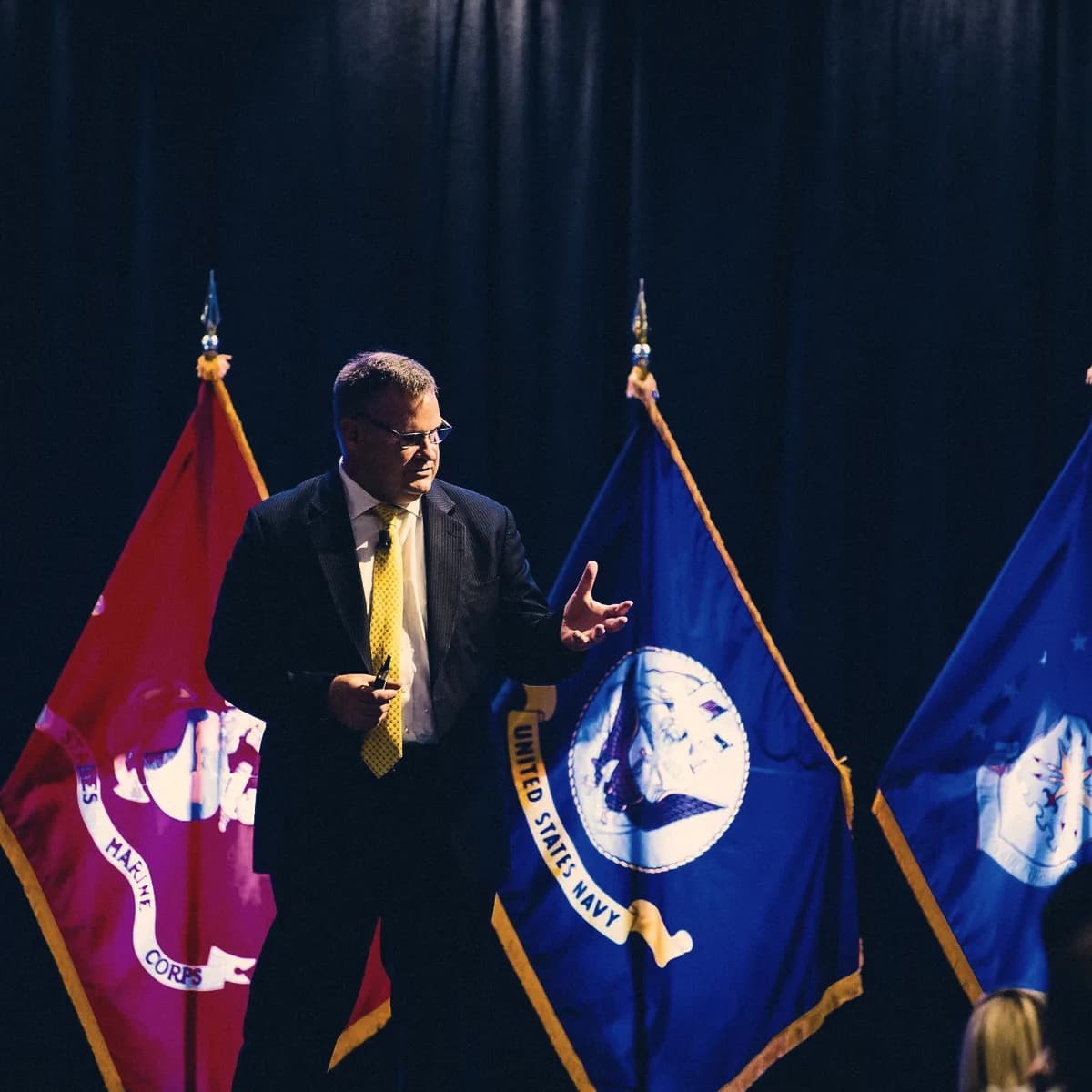
We built Lived Path for a decision that has to be made under uncertainty, and for living with what follows. If they cannot show what changed, they have not finished.
Colonel John Fenzel, U.S. Army (Ret.). Special Forces, three tours in Bosnia, White House Fellow, staff director on the Homeland Security Council.
Why I built Lived PathHow it starts
Three steps to the first retreat.
A conversation
With John, about what your leaders have to get done this year.
A scoped proposal
Cohort size, the calendar, the grounds, the case library and the security pack.
A date
The Commission Leadership Retreat goes on the calendar.
The year
The year begins on the ground.
Four field days: Gettysburg, Antietam, Arlington and Washington, and Normandy.
Two leadership retreats bracket the year. Twelve cases run in the stretches between the grounds, three before each field day.
How it works
Every case makes them decide twice.
The first call is the plan. The second is what the plan caused. A case coach argues the other side, and it cannot see the ending either.
A leadership coach meets each leader once a month and works from the Leader Support Form: their leadership philosophy, the values they will defend and their objective.
Evidence
We ask the people around them what changed.
A satisfaction score tells you the room was warm. We go to the leader's manager and team at the start and again at the end.
Commission to Reckoning
Commission opens the year. Reckoning ends it.
At the Commission Leadership Retreat, two and a half days, the cohort forms and every leader writes down the one thing they mean to get done this year.
At the Reckoning Leadership Retreat, each leader stands up and says what actually changed in their work.

Is this for you
Who the year is for.
It fits an organization that will release eight to twelve leaders for field days across the year, can name what those leaders have to get done, and has managers who will hold a check-in at the end of each stretch.
It does not fit an organization that wants a single offsite, needs to read what its leaders write in private, or wants a satisfaction score as the outcome.
Ways to start
Start with one day, one team, or the year.
A field day
One day for your executive team, at Gettysburg or Antietam, built around one decision you face this year. If you go on to the year within 90 days, the field day counts toward it.
Ask about a field dayA pilot with one team
One team, one cohort, twelve weeks. You see the case library, the evidence instruments and the security pack before you commit.
The year
Two leadership retreats, four field days and twelve cases, built for one company and one team.
The price depends on the size of the cohort, the grounds you walk, and whether you start with a field day, a pilot or the year. The scoped proposal states it after the first conversation, before you commit to anything.
Most begin with a pilot. Every engagement is scoped with you.
Questions buyers ask
Before you bring this to your leadership team
How much of my people's time does this actually take?
About 90 minutes a week. About 40 minutes go to the case and its two decisions. The rest goes to applying it to work they already have and writing a short review. There are four live sessions, one at the close of each stretch.
How is this different from coaching platforms or classroom leadership programs?
Those are largely conversation-based and measured on self-report. Lived Path is practice-based. Your leaders commit to decisions before the outcome is visible, lead through the consequences and apply each one to live work. After the twelfth case, the people they work with are asked what helped and what got in the way. One-to-one coaching works well alongside it.
Can we see what our people wrote?
You see applications, completion and manager check-ins. Reflections, case coach transcripts, Advisor threads and what their team wrote back stay with the leader. Lived Path cannot read them either. Security and privacy
What is the smallest way to start?
A pilot: one team, one cohort, twelve weeks. Some organizations start with a single field day for their executive team.
Bring a cohort into your organization.
One conversation with John, then a scoped pilot with a single team.
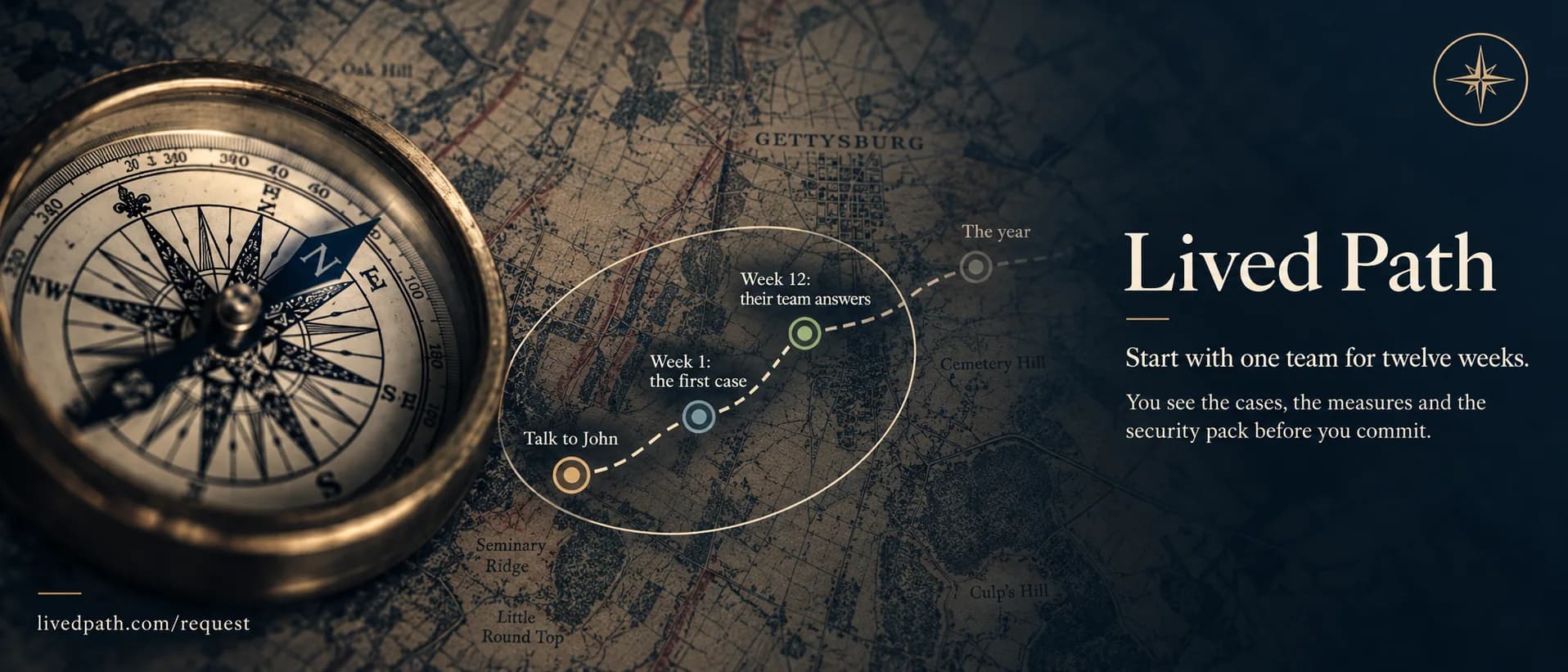
John replies within two working days. A brief you can forwardTry a decision