
How we measure
We ask the people around them what changed.
A satisfaction score tells you the room was warm. We go to the leader's manager and team at the start and again at the end. Then we keep asking for six months.
The four behaviors: gathers the facts and the other side; puts the team first; decides in time and owns it; reviews and changes.
Before the first case
Leader and manager rate four behaviors.
Each scores the same four behaviors from 1, rarely, to 5, consistently. They seldom agree everywhere, and the gap is where the first useful conversation starts.
After the twelfth case
The same two people rate them again.
Same behaviors, same scale. The leader also asks the people they work with what helped and what got in the way. Nothing opens until at least three have answered.
For six months after
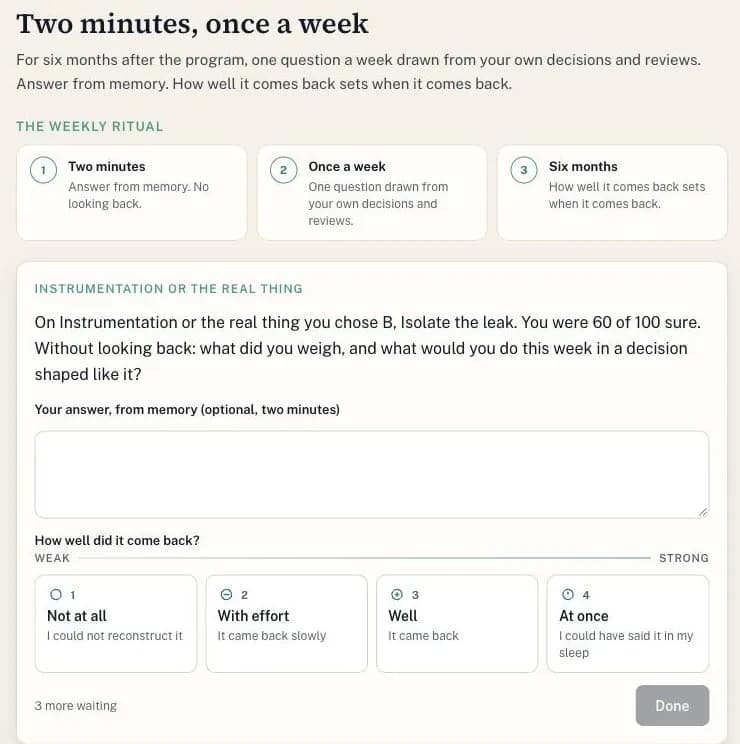
Two minutes, once a week.
A short prompt built from a decision the leader made in the program. The spacing brings each lesson back as it starts to fade.
Three and six months on
The four behaviors, checked again.
Leader and manager answer one question for each: since the program ended, how often have you seen this at work? Your sponsor sees the cohort's averages.
Start and finish
Rated twice by the same two people.
The leader rates themselves. Their manager rates them too. Both use the same four behaviors and the same five-point scale, once before the first case and once after the twelfth.
Each behavior is something a colleague can watch a leader do, so a manager can say whether it happened.
What the report shows
One leader, seen from two sides.
Morgan Hale runs operations at Harbor Light Logistics, the example company inside the platform. Morgan rates the four behaviors, and so does Jordan, Morgan's manager. Before the first case their views sat a point apart on Serve and on Lead.
After the twelfth case their views matched on three of the four. On Remember, Jordan saw the behavior more often than Morgan noticed it.
- Morgan's own view
- Jordan's view, as manager
- The same view
See the numbers
| Behavior | Morgan, before | Jordan, before | Morgan, after | Jordan, after |
|---|---|---|---|---|
| LearnGathers the facts and the other side before deciding | 3 | 3 | 4 | 4 |
| ServePuts the team and the mission ahead of personal standing | 3 | 2 | 4 | 4 |
| LeadDecides in time, states the reason, and owns the result | 2 | 3 | 4 | 4 |
| RememberReviews decisions after the fact and changes behavior because of them | 2 | 2 | 4 | 5 |
After the twelfth case
What the team saw.
The people who work with a leader know things their manager never sees. So at the end, the leader asks them.
- The leader invites themThe people they work with day to day.
- Each one writes backWhat helped, and what got in the way.
- The answers stay sealedNothing opens until at least three are in, so no one can be singled out.
- The leader reads themTheir manager sees that the team answered. Never what they wrote.
Recall
Two minutes a week, for six months.
After the last case, a short prompt arrives once a week. Each one is built from a decision the leader made or an after-action review they wrote. It takes about two minutes.
The schedule spaces them out. A lesson the leader has nearly lost comes back sooner, and one they hold well waits longer.
Three and six months on
Did it hold?
Since the program ended, how often have you seen this behavior at work?
The leader and their manager answer it for each of the four behaviors. They also say whether the leader used something from the program at work in the last month.
Your sponsor sees the cohort's averages. A single person's answer never reaches the sponsor.
The record
A record that keeps working
Each leader who finishes receives a signed credential. Anyone can verify it from a link, with no account, years after the program ends.
Each leader earns five credentials across the year: one for each stretch, and one for the program. The examples below were made by the same code that issues the real ones, for an example leader, Morgan Hale, at an example company, Harbor Light Logistics.
Five credentials, earned in order
Each one carries the company's mark beside Lived Path's. A leader earns a stretch credential only with a committed decision and an application at work for every case in it.
 LearnThree Learn cases, each with a committed decision and an application at work.Gathers the facts and the other side before deciding.
 ServeThree Serve cases, each with a committed decision and an application at work.Puts the team and the mission ahead of personal standing.
 LeadThree Lead cases, each with a committed decision and an application at work.Decides in time, states the reason, and owns the result.
 RememberThree Remember cases, each with a committed decision and an application at work.Reviews decisions after the fact and changes because of them.
 Leading Under PressureAll four stretches, including an application the manager can see and a written after-action review.The program credential. It comes with the certificate.
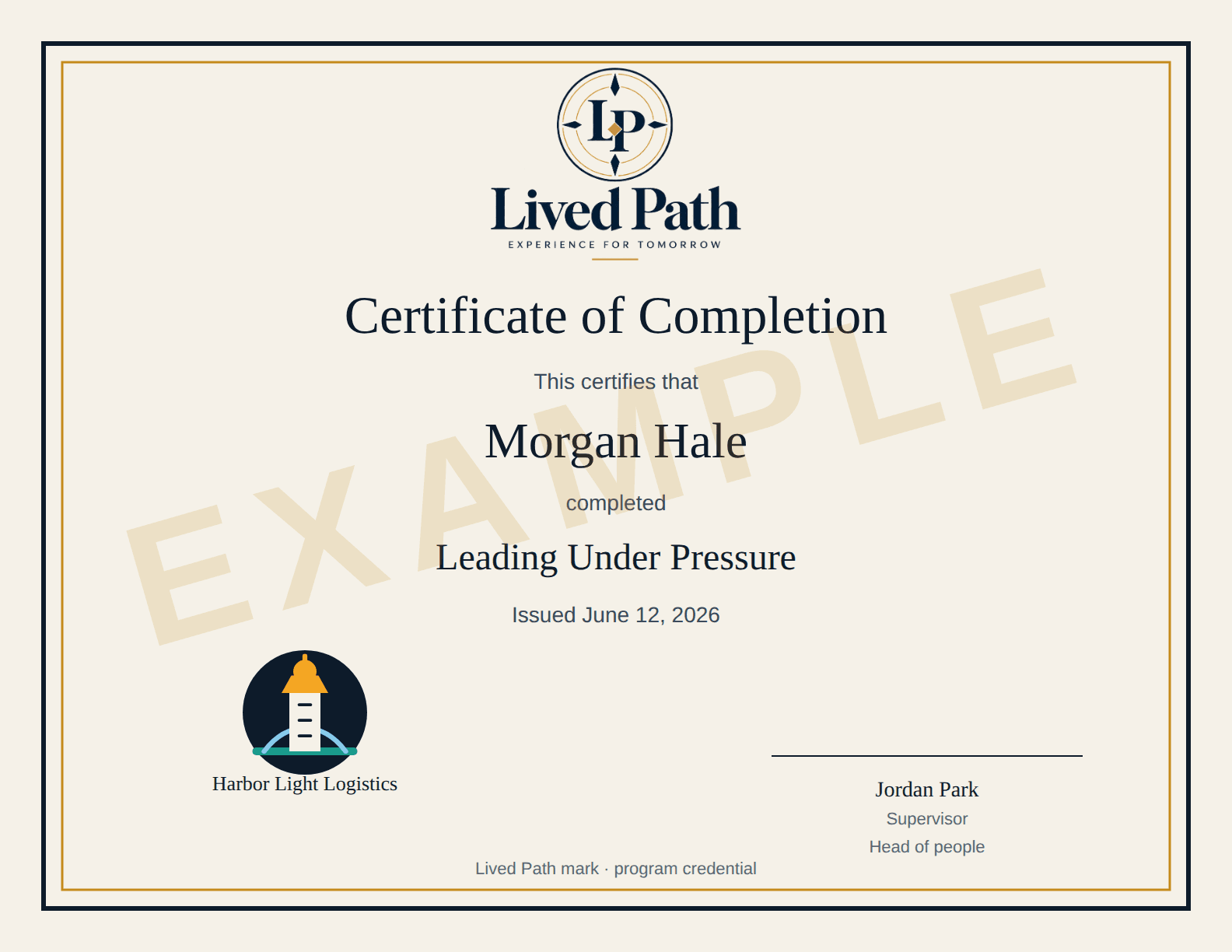
The certificate
The program credential comes with a certificate in the leader's name. It carries the company's mark and the name of the manager who signs off. It downloads as a PDF to print and as an image to share.

Anyone can check it
Every credential has its own link. The page shows the title, the holder, the company, the date, and whether the credential is still valid. It checks the signature against Lived Path's published key. A company can revoke a credential, and the page then says so. Nothing the leader wrote in the program appears there, or anywhere public.
A record other systems can read
Under the badge is a signed record in an open standard. It belongs to the leader, and it keeps working if your company changes providers.
- One step adds it to the Learner Credential Wallet or to a LinkedIn profile.
Outcomes
What we can show at the end of the year.
Change is proved at Reckoning, in a brief other people can challenge. We read it from what each leader wrote and did during the year. We do not publish a rate of return, a dollar figure, or a metric we made up.
| What we read | Where it shows | When |
|---|---|---|
| What changed in the leader | The Reckoning brief names what changed and where it showed in the work, with a ninety-day commitment other people will be able to see. Peers and the leadership coach challenge it. | Reckoning |
| Judgment under pressure | One decision made while the picture was still partial, and what happened at work after it. | Reckoning |
| The Leader Support Form | The philosophy, the values they will defend, the development plan and the objectives, worked with the leadership coach every month. | Monthly, the midpoint, Reckoning |
| Character | The values they defended, trust kept by being consistent, humility when they were wrong, and ownership of the call. | Reckoning |
| Level 5 | Humility joined to will, the standard Jim Collins set out in Good to Great, read from the brief and from the work. | Reckoning |
| The team | One standard held across the cohort, and each leader holding it with the people they lead. | Through the year |
| What managers see | Applications and progress. Private reflections stay with the leader. | Between field days |