

Leading Under Pressure
How it works
Twelve real decisions across the year, each with the ending sealed until the leader commits. Between the field days, the platform keeps the work going.
How it works
Every case makes them decide twice.
You will never lead with hindsight. So we take it away.
Twelve decisions, each from a real moment when someone had to choose under uncertainty, with a deadline and no good options: a flight controller reading an instrument, a physician who refuses to sign off, a senator who stands up in a room that has already agreed.
The first call is the plan. The second is what the plan caused, on the branch they chose.
At work, second and third order effects arrive late enough to look like somebody else's fault. Here they arrive in the same session, with fewer options and an audience that formed while they were deciding.
The outcome stays sealed in the software until they commit.
Try one yourself: five minutes, one real decision, the ending sealed until you commit. Try a decision
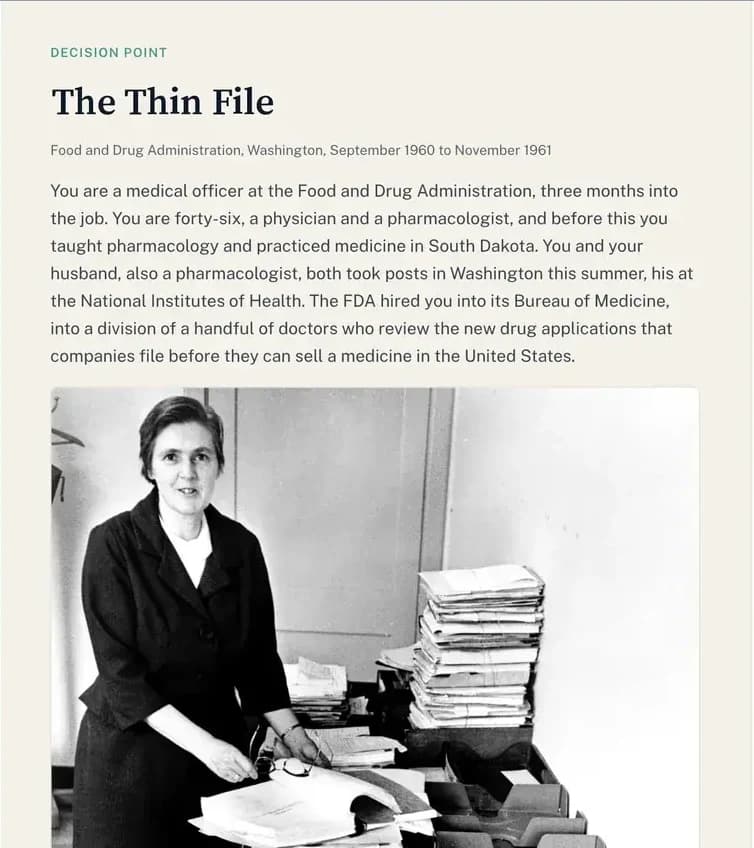
A case coach that argues the other side.
The case coach works the case with them before they commit. It asks what they have assumed and what they have not yet seen. Then it makes the best case for the option they are leaning against, whichever one that is. The higher a leader rises, the less dissent reaches them, and the case coach is where they practice hearing it.
It cannot see the ending either. Ask it for the answer and this is what it says:
They asked: Just tell me which one they picked.
That stays closed until you commit. There is no answer key. Tell me which option you lean toward and I will argue the other side.
Then they have to carry it at work.
Each decision comes back as something they do on the job and write up afterwards: a call to communicate, a standard to hold, a position they may have to change in front of their team.
Tell us what your leaders have to get done this year. The cases work on that, and the commitments are checked against it.
What they write in private stays private.
- The applications
- The check-ins
- Completion
- Their reflections
- Every word to the case coach
- Advisor, their private planning dashboard
- What their team wrote back
Lived Path cannot read what stays with the leader either. Who can read what, in full
How the year teaches
Commission, the field, then Reckoning.
Commission opens the year. The field days test what each leader said they would do. Reckoning closes it, in front of people who can challenge the claim. Each part has one job.
How we teach
We look at what is in front of the leader, argue it until the choice is plain, take the action with them, and measure the result. It is the Socratic method, practiced on the ground where the decision was made.
Character-driven leadership
Trust has to be consistent. Humility has to show when a leader is wrong. A leader owns the decision they made, and an excuse is not a decision.
The Leader Support Form
Each leader writes a personal leadership philosophy, the values they will defend, a development plan, and their personal and professional objectives. The leadership coach comes back to the form every month. The leader revises it at the midpoint of the year, and Reckoning reads it again.
Level 5
When the work turns to competence, we hold leaders to what Jim Collins called Level 5 leadership in Good to Great: personal humility joined to professional will. At Reckoning we ask whether the will served the work.
Two books run through the year
The Killer Angels, Michael Shaara. Each leader is assigned one figure from the battle at Commission and finishes the book before Gettysburg.
Lessons from the Hanoi Hilton, Taylor Baldwin Kiland and Peter Fretwell. Read across the year, on what a team holds onto when the pressure does not let up.
A team of teams
The cohort has to work as one team. Each leader then carries that standard back to the people they already lead.
The questions they take home
A field day is finished only when it reaches the leader's desk. Every month the leadership coach asks three questions, and Reckoning asks them again.
- What do you see?
- Who else has to live with this choice?
- What will show when you are back at work?
A second case library, Standing Alone, is also available. Your scoped proposal recommends one.
What we teach
A decision is one moment. Leading is the five around it.
Most programs train the moment of choice: the frameworks, the decision trees, the bias checklists. By the time a hard call reaches the table, most of the leadership has already happened, or already failed.
- 01
Notice
Seeing a problem early. Most leaders who get blindsided had people around them who already knew.
- 02
Frame
The question you were handed is rarely the question you face. Finding the real one, and knowing before you move what would change your mind.
- 03
Counsel
Seeking out the people who see it differently, and inviting the hard questions while the answer can still change.
- 04
Decide
Making the call on time, and owning it.
- 05
Carry
Explaining the decision so people can act, holding it when that is hard, and changing it openly if the facts change.
The four stretches carry all five: Learn trains Notice and Frame, Serve trains Counsel, Lead trains Decide, and Remember trains Carry.

Leaders spend a few seconds deciding and the next two quarters inside what they decided.
Between the field days
What a leader opens each week.
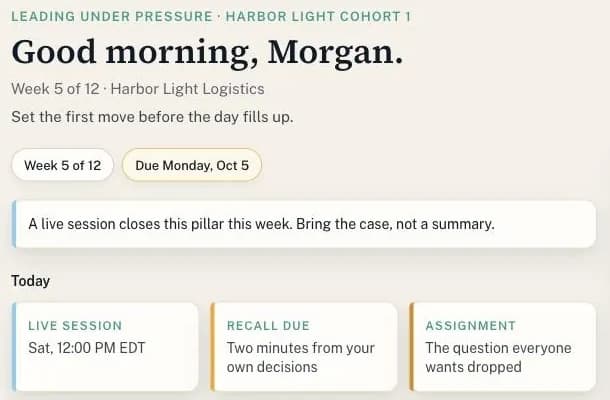
This week's case, and the assignment still open.
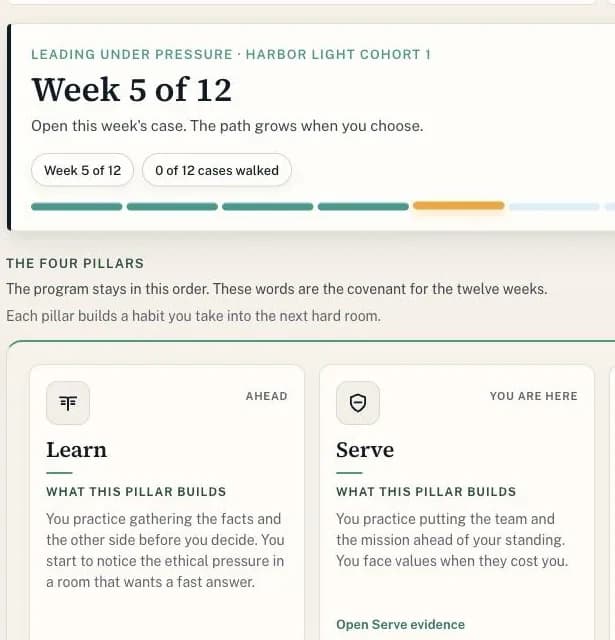
Where the year stands, case by case.
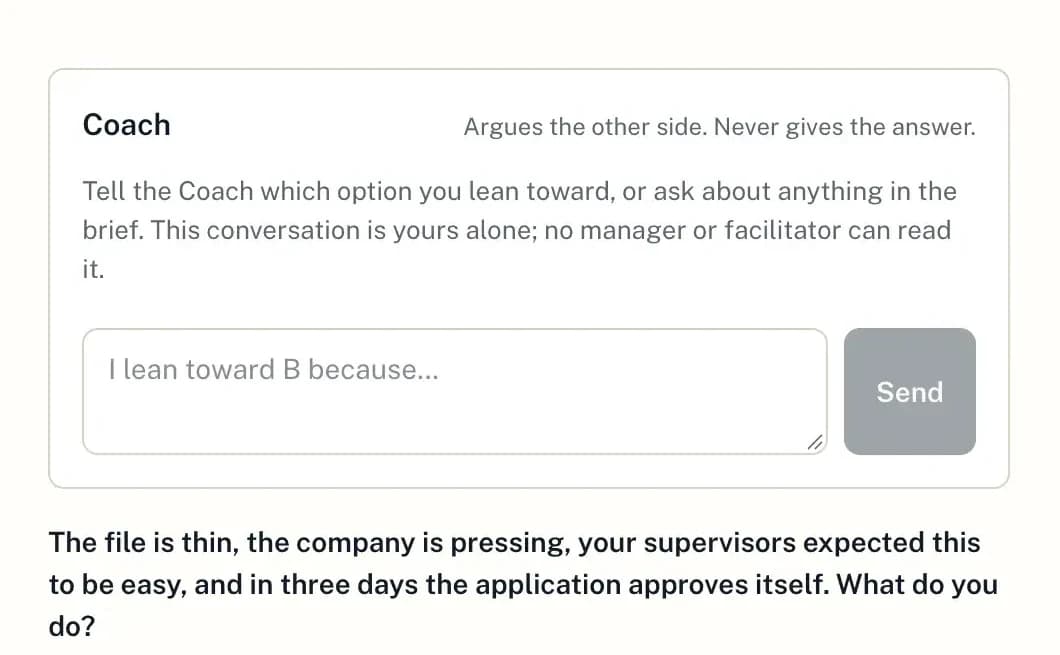
It argues the other side and never gives the answer.
Coaching
A leadership coach every month.
A leadership coach meets each leader once a month and works from the Leader Support Form: their leadership philosophy, the values they will defend and their objective. The form is revised at the midpoint of the year and read again at Reckoning.
Your organization may see trends across the cohort. It never sees what a leader wrote.
More on the Leader Support FormAdvisor
Advisor holds the year together.
Advisor is each leader's own dashboard. The weekly case, the cohort sessions, the commitments they write, the work they take back to their job and the one objective they wrote all run through it, in one record. It keeps running for six months after the last case.
It does three jobs. It maps the aim, the way, the means and the date. It names what to stop and what comes next. It checks whether the work should hold, slip or move.
It argues only from the leader's own record: what they wrote, what they chose, what they committed to. Every exchange ends with one thing they will do, in their own words. Nobody else can read it.
What a manager sees
Applications and progress. Reflections, coaching and Advisor stay with the leader. Who can read what, in full
Bring a cohort into your organization.
John replies within two working days.